
REVIEW · PARIS
A Tapestry of Art and Romance in Montmartre
Montmartre’s charm is not just the white dome of Sacré-Coeur. It is the odd mix of cabarets, painters, singers, old windmills, narrow streets, and romantic corners packed into one hilltop neighborhood. This 90-minute walking tour connects those pieces in a sensible route from the Moulin Rouge to the basilica.
I like two things right away: the guide gives Montmartre its cultural context instead of simply pointing at famous façades, and the pace can bend to suit the group. Arthur has slowed down for guests with bad knees, waited while people took photos, and allowed breaks when needed. The main consideration is that this is a short walking tour with several stops, not a full visit inside Sacré-Coeur or the Moulin Rouge.
Key points at a glance
- From cabaret to church: Follow a route that begins at the Moulin Rouge and ends outside Sacré-Coeur.
- Artists in their old quarter: Learn about the Bateau-Lavoir, Picasso’s connection with La Maison Rose, and the artistic life around Place du Tertre.
- A guide-led neighborhood walk: Expect stories and local context rather than a simple checklist of sights.
- Flexible pace: Guides have accommodated slow walkers, photo stops, bad knees, rain, and cold.
- Good short-tour value: At $36.12 per person, the price covers a professional guide and a focused introduction to one of Paris’s most distinctive districts.
- English and mobile ticket: The tour is offered in English, and confirmation arrives when you book.
Starting at the Moulin Rouge on Boulevard de Clichy

The tour begins at the Moulin Rouge, the red windmill-topped cabaret that has become one of Paris’s best-known symbols. You explore it from outside, with about 10 minutes set aside for the stop. That means this is a quick orientation and photo opportunity, not a cabaret performance or interior visit.
That limitation is worth understanding before you book. If your main goal is a show, dinner, or a look inside the Moulin Rouge, you need a separate plan. Here, the cabaret serves as the opening chapter in a walk through Montmartre’s entertainment and art-filled past.
From this starting point, the route moves away from the busy boulevard and toward the neighborhood’s more personal stories. The contrast matters. Montmartre is often sold as a pretty hill with a church on top, but its character comes from the people who lived, worked, painted, performed, and argued here.
A few more romantic experiences around Paris worth a look
- Paris: Romantic Cruise with 3-course Dinner on Seine River
★ 4.3 · 2,295 reviews - Paris Private Romantic Horse & Carriage Ride
★ 4.5 · 414 reviews - Romantic Paris Vintage Citroën 2CV Tour
★ 4.6 · 198 reviews
A sweet pause at the Wall of Love
Le Mur des Je t’aime, or the Wall of Love, gets about 10 minutes. The wall displays the phrase I love you in many languages, making it an easy photo stop and a natural fit for a tour built around art and romance.
Do not expect a long historical talk here. Its value is more immediate: you get a brief break, a memorable picture, and a small reminder that Montmartre’s appeal is not only serious art and grand monuments. The stop also breaks up the walking route before the tour turns toward the district’s artists.
If you like taking photos, this is one place where the guide’s patience can make a difference. Arthur has waited while guests photographed the sights, and the tour’s small-stop format gives you chances to look around instead of being hurried from one landmark to the next.
Bateau-Lavoir and the artists of Montmartre
The longest stop is Le Bateau-Lavoir, with about 20 minutes devoted to its role in Montmartre’s artistic story. This is where the tour moves beyond postcard Paris and explains why the neighborhood mattered so much to painters and other artists in the late 19th and early 20th centuries.
The name is linked with a laundry boat, and the building became associated with artists who lived and worked in modest conditions. The important point for you is not simply the building itself. It is the chance to understand how Montmartre became a place where artists gathered, exchanged ideas, and helped shape modern art.
The stop is described as an exterior visit, so you should not expect access to private interiors. Still, a guide can give the site meaning that a quick photograph cannot. Without context, an old building may look ordinary. With the story of the artists who lived there, it becomes part of the neighborhood’s identity.
This is also where the guide’s style matters most. The strongest part of the experience is likely to be the explanation, not a dramatic entrance or a long list of dates. Arthur is presented as especially passionate about Montmartre, and the tour is designed around that personal knowledge of the area.
Moulin de la Galette and the old village atmosphere
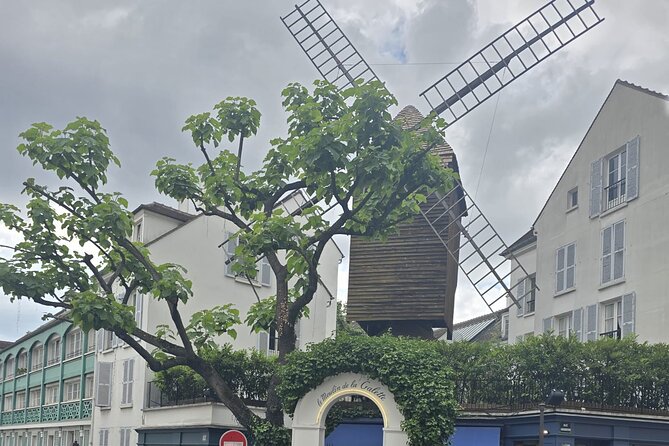
Le Moulin de la Galette receives about five minutes. The site recalls one of Montmartre’s famous 19th-century restaurants and the windmills that once marked the hill.
Five minutes is enough for a quick explanation and photograph, but not for a meal or a lengthy visit. Admission is not included, and the tour does not turn into a restaurant stop. Think of it as another piece in the neighborhood’s story: Montmartre was once a place of mills, dance halls, modest homes, and country-like scenes on the edge of Paris.
That old village feeling is one reason this walking route works. The tour links places that can seem unrelated if you visit them alone. A cabaret, a windmill, an artist’s residence, and a famous restaurant begin to form one picture of Montmartre as a place where ordinary life and creative ambition shared the same streets.
Same place, a different kind of evening:
- Paris Renew Your Wedding Vows Experience with Professional Photographer
★ 5.0 · 219 reviews - Paris: Romantic Photoshoot for Couples
★ 4.9 · 131 reviews - Paris: Romantic Piano Concert at Saint-Julien-le-Pauvre
★ 4.7 · 126 reviews - Classic, Romantic Paris: 3-Hour Vintage 2CV Tour
★ 4.7 · 120 reviews
Dalida’s bust and the neighborhood’s musical side
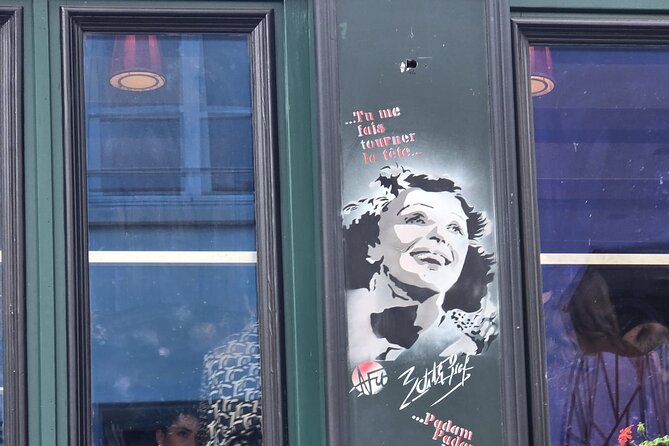
The stop at the Buste de Dalida lasts about five minutes. Dalida was a famous French singer whose career helped shape French popular music in the 1970s. Her connection to Montmartre adds a musical thread to a district often described only through painters and writers.
This is a small stop, but it broadens the tour. You are not seeing a neighborhood preserved only for its artistic past. You are also meeting one of the people who gave Montmartre a place in modern French culture.
The bust is a quick landmark rather than a museum visit. If you want a detailed study of Dalida’s life or music, this tour will only provide an introduction. For most people, that is enough to add another layer before the route continues to La Maison Rose.
La Maison Rose and the picturesque side of Montmartre
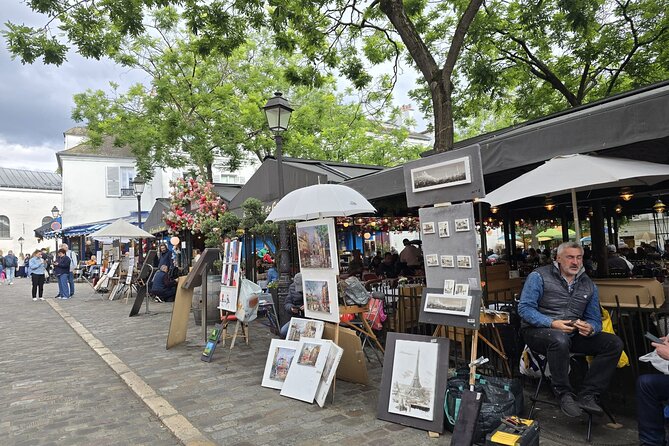
La Maison Rose is one of Montmartre’s most recognizable restaurants, with its pink exterior and corner setting. The tour allows about five minutes here and explains its place in the neighborhood’s artistic world, including its association with Pablo Picasso.
This is an easy spot to photograph, but the photo is not the whole point. La Maison Rose shows how Montmartre’s appeal often comes from the combination of setting and story. A brightly colored restaurant may look like a pleasant picture, yet the connection with artists gives it a stronger place in the district’s cultural memory.
Admission is not included, and the tour does not promise a meal. If you want to eat here, you would need to make that a separate plan. The short visit is better viewed as an exterior landmark stop, with the guide supplying the background.
Place du Tertre, where Montmartre gets its artistic reputation
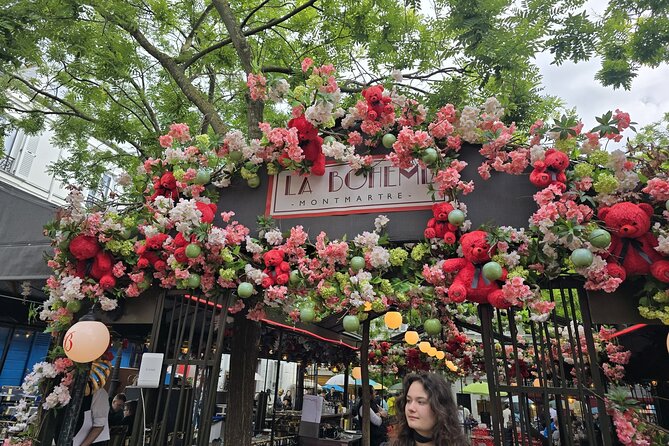
Place du Tertre is the heart of the old artistic district, and the tour sets aside about five minutes for it. This is where you can picture Montmartre’s reputation as a place of painters, portrait artists, cafés, and street life.
The stop is brief, so you should not expect a long period to browse every artist’s table or settle in for a drink. What you do get is a clear introduction to the square and its role in the district. The guide can help you see it as more than a photogenic plaza.
I like having Place du Tertre near the end of the route. By then, the earlier stops have given you the basic story of Montmartre’s artists, singers, restaurants, and entertainers. The square becomes a natural gathering point for all those themes before the final climb toward Sacré-Coeur.
Ending beneath the dome of Sacré-Coeur
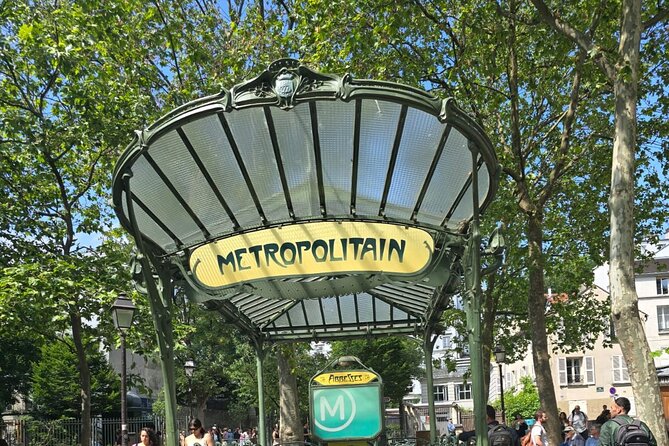
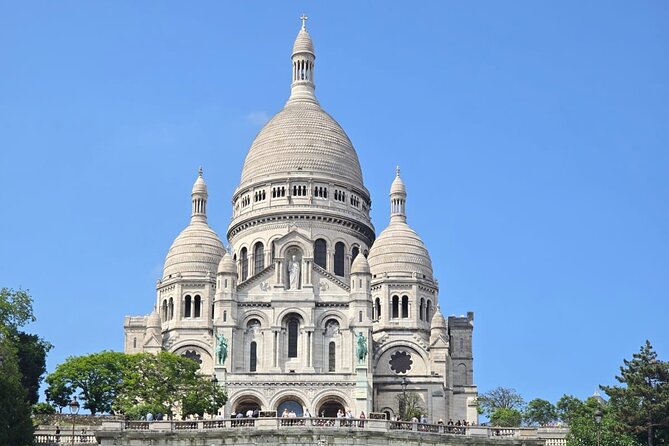
The tour ends outside the Basilique du Sacré-Coeur de Montmartre, the white-domed church that serves as Montmartre’s most recognizable symbol. About 10 minutes are planned here, and the basilica itself can be visited on your own after the walk.
This arrangement gives you useful flexibility. You receive an introduction to the building and its place in Montmartre, then decide whether you want to go inside, take more photos, or spend time enjoying the hilltop area. Since the guided visit ends outside, admission to the basilica is not part of the experience.
The ending point is practical as well as scenic. You finish with one of Paris’s major landmarks directly in front of you rather than being taken back to the starting point. If you still have energy, you can continue exploring on your own. If you have had enough walking, you can stop after the guide’s farewell.
A guide who adjusts to the group
The best feature of this tour is its human pace. Arthur has slowed down for someone who could not walk quickly, stopped for a guest with bad knees, and allowed time for photos. One booking even became a private tour because only one person had reserved, giving that guest a more personal experience.
You should not assume every departure will be private. The advertised group limit is 50 people, which is a fairly large maximum for narrow streets and short stops. The actual feel can depend on the number booked on your date.
The guide has also used prepared photos and materials when rain and cold made explanations harder to follow. That suggests a practical approach: the tour is not built only around pointing at buildings. The guide may use visual help when the weather or setting makes the story less clear.
Most people can participate, and service animals are allowed. The route is near public transportation. Still, this is a walking tour on Montmartre’s hill, so anyone concerned about pace should contact the provider before booking. The guide has shown patience, but the experience remains a walk rather than a seated sightseeing trip.
What $36.12 buys you
At $36.12 per person, the cost is reasonable if you want an organized introduction to Montmartre without committing half a day. The tour lasts about 90 minutes and includes a professional guide, an English-language explanation, and a route covering eight notable stops.
The value is strongest for a first visit or for anyone who wants the neighborhood to make sense quickly. You are paying for the connections between places: why the artists mattered, how the restaurants fit the story, and why Montmartre became such an important part of Parisian culture.
The price does not include coffee or tea, tickets to the Moulin Rouge, food at La Maison Rose or Moulin de la Galette, or entry inside Sacré-Coeur. Those exclusions are not surprising, but they affect your budget. You should treat the tour as a guided walk, not as a meal, performance, or church admission package.
The 90-minute length is another part of the value. You can fit it into a busy Paris schedule, then continue at Sacré-Coeur or return to the sights that caught your attention. The tradeoff is that each stop receives only a short visit, with Bateau-Lavoir getting the most time.
Who should book this Montmartre walk
I would choose this tour if you want a clear first look at Montmartre, prefer stories to a silent stroll, and like having a guide who can answer questions along the way. It suits couples drawn to the romantic side of the district, families who want a manageable introduction, and solo visitors who would rather not piece together the route alone.
It is also a good fit if you are interested in artists and French music, not just major churches. The Bateau-Lavoir, Dalida’s bust, La Maison Rose, and Place du Tertre give the walk more range than a simple Moulin Rouge to Sacré-Coeur photo route.
You may want another option if you need interior access, a full meal, a cabaret show, or a long, highly detailed art lecture. You should also allow extra time after the tour if you want to visit Sacré-Coeur yourself, since the guided portion ends outside.
Booking confirmation is provided at the time of purchase, and a mobile ticket is available. The activity is offered in English and is often booked well ahead, with an average booking lead time of 41 days. Free cancellation is available up to 24 hours before the start time. Cancellations or changes made inside that window are not refunded or accepted.
Should you book it?
Book this walk if you want Montmartre explained by a patient guide, with a route that mixes cabaret, romance, artists, music, restaurants, and Sacré-Coeur. The strongest reason to choose it is the guide’s ability to adjust the pace and add meaning to places that can otherwise feel like quick photo stops.
At $36.12, it is a fair buy for a focused 90-minute introduction. Just keep your expectations clear: you see the Moulin Rouge and Sacré-Coeur from outside, and the short stops favor a broad neighborhood portrait over long visits. Add your own time at the basilica afterward, and this becomes a practical way to get your bearings on Montmartre’s famous hill.
FAQ
How long does the Montmartre walking tour last?
The tour lasts approximately 1 hour and 30 minutes.
Where does the tour begin?
It begins at Blanche, 75018 Paris, France, near the Moulin Rouge.
Where does the tour end?
The tour ends in front of the Sacré-Coeur Basilica at 35 Rue du Chevalier de la Barre, 75018 Paris.
Is entry to Sacré-Coeur included?
No. The guided visit ends outside the basilica, which you can visit on your own.
Is the Moulin Rouge admission included?
No. The Moulin Rouge is explored from the outside, and admission is not included.
Is the tour offered in English?
Yes. The experience is offered in English.
Is coffee or tea included?
No. Coffee and tea are not included in the price.
Can I cancel the booking for a refund?
Yes. You can cancel at least 24 hours before the start time for a full refund. Cancellations or changes made less than 24 hours before the start time are not accepted or refunded.
Just added around Paris
- Paris: Romantic Couple Photoshoot (with flower bouquet!)★ 4.2 · 6 reviews
- Paris Luxembourg Garden Wedding Vows Renewal Ceremony with Photo Shoot★ 4.5 · 7 reviews
- Private Romantic Photoshoot in Paris with Bouquet of Flowers★ 5.0 · 3 reviews
- Romantic Tour of Paris in a Vintage Luxury Open-Top French Car★ 5.0 · 5 reviews
- Valentine’s Day Seine River Champagne Cruise★ 5.0 · 2 reviews
- Live, Laugh, Love Along the Seine: Self-Guided Romantic Tour★ 5.0 · 9 reviews
- Private Proposal Photoshoot in Paris★ 5.0 · 5 reviews
- Parisian Romantic Picnic★ 5.0 · 26 reviews
Paris Romantic Experiences, compared.

Romantic Cruise with 3-course Dinner on Seine River
Read our review →
Paris Renew Your Wedding Vows Experience with Professional Photographer
Read our review →

Romantic Piano Concert at Saint-Julien-le-Pauvre
Read our review →
Classic, Romantic Paris: 3-Hour Vintage 2CV Tour
Read our review →
Paris Eiffel Tower Wedding Vows Renewal Ceremony with Photo Shoot
Read our review →Browse the lists this tour appears in